

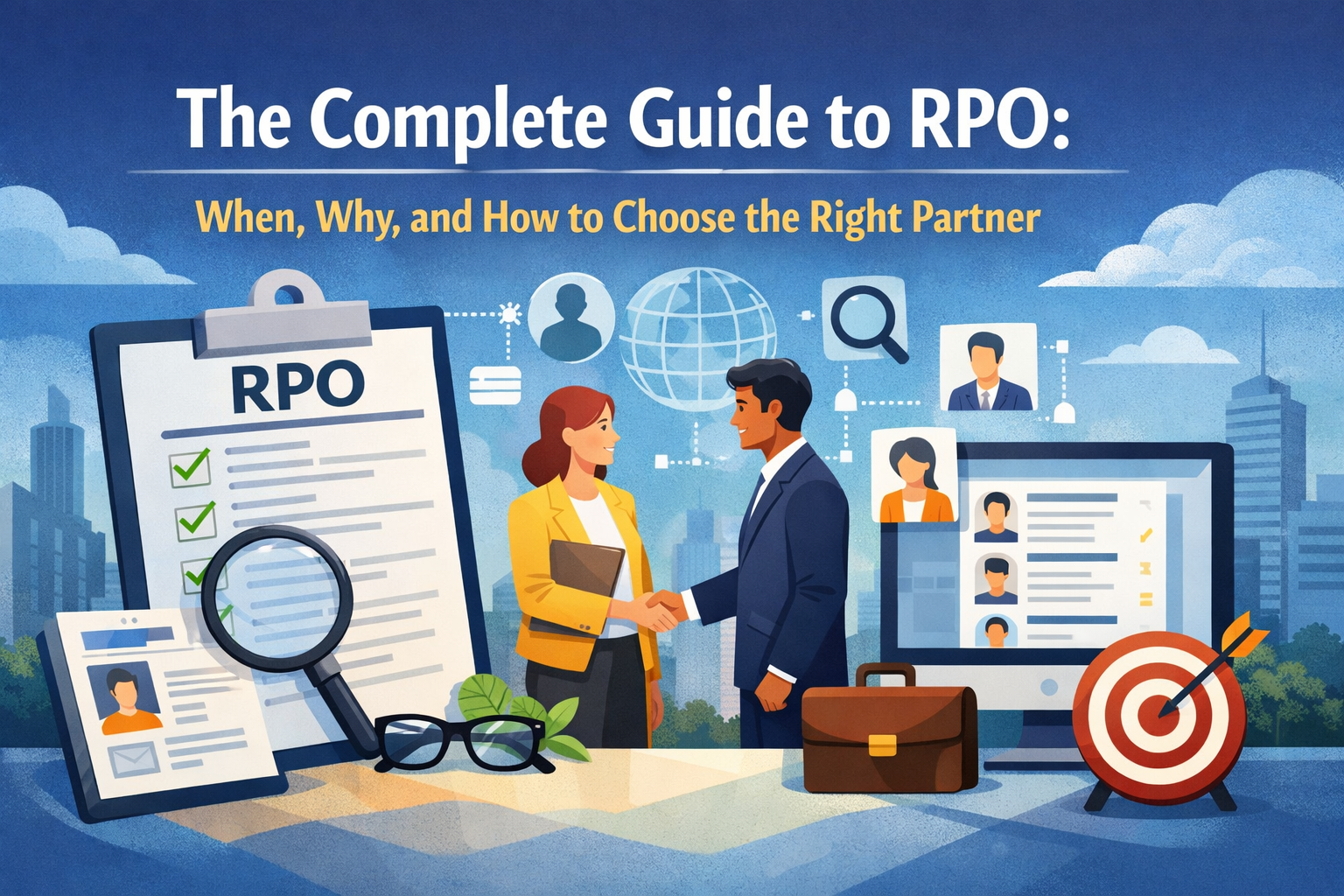
The Complete Guide to RPO: When, Why, and How to Choose the Right Partner
In today's competitive talent landscape, companies face a critical challenge: how to hire quality candidates quickly without compromising on standards or overwhelming internal teams. For many organizations—from fast-growing startups to enterprise corporations—Recruitment Process Outsourcing (RPO) has emerged as a strategic solution. But what exactly is RPO? When does it make sense for your business? And how do you choose the right partner? In this comprehensive guide, we'll break down everything you need to know about RPO and how it can transform your hiring outcomes.
What is RPO? Beyond the Buzzword
Recruitment Process Outsourcing (RPO) is when a company transfers all or part of its recruitment processes to an external service provider. But here's what many people miss: RPO isn't just outsourcing—it's a strategic partnership.
Unlike traditional staffing agencies that work on a transactional, per-placement basis, RPO providers become an extension of your team. They:
- Embed themselves in your company culture
- Take ownership of recruitment outcomes
- Use your branding and processes
- Focus on long-term hiring success, not just filling positions
Think of it as having a dedicated, expert recruiting team without the overhead of building one in-house.
The RPO Spectrum: Full vs. Partial vs. Project-Based
RPO isn't one-size-fits-all. There are several models to consider:
1. Full RPO
The provider manages your entire recruitment function—from sourcing to offer acceptance.
Best for:
- Companies with high-volume, ongoing hiring needs
- Organizations without a large in-house recruiting team
- Businesses undergoing rapid growth or transformation
2. Partial RPO (Selective RPO)
Outsource specific parts of recruitment—like tech hiring, executive search, or sourcing only.
Best for:
- Companies with some internal recruiting capacity
- Organizations hiring for specialized roles
- Businesses wanting to supplement internal teams during peak periods
3. Project-Based RPO
Short-term engagement for specific hiring projects (e.g., opening a new office, launching a new product line).
Best for:
- Companies with temporary hiring surges
- Startups scaling quickly
- Businesses entering new markets
5 Clear Signs You Need an RPO Partner
Not sure if RPO is right for you? Here are the telltale signs:
1. High-Volume Hiring is Overwhelming Your Team
If your HR team is drowning in resumes, spending 80% of their time on administrative recruiting tasks, and still can't keep up—you need help.
The Impact:
- Burnout among HR staff
- Delayed hiring timelines
- Missed opportunities for top talent
The RPO Solution: Dedicated recruiting teams handle the volume while your internal HR focuses on strategy, onboarding, and employee development.
2. Time-to-Hire is Affecting Business Growth
When critical positions remain open for months, it doesn't just slow growth—it actively damages your business.
The Cost:
- Lost revenue opportunities
- Increased workload on existing staff
- Competitive disadvantage
The RPO Solution: Specialized recruiters with established talent networks and advanced sourcing technology can cut time-to-hire by 30-50%.
3. Quality of Candidates Isn't Meeting Expectations
Getting plenty of applications but few qualified candidates? Your sourcing strategy needs an upgrade.
The Problem:
- Generic job postings attracting wrong candidates
- Limited access to passive talent
- Ineffective screening processes
The RPO Solution: Industry-specialized recruiters know where top talent hangs out and how to attract them. Plus, AI-driven matching ensures better candidate-role fit from the start.
4. You Lack Specialized Recruiting Expertise
Hiring for niche technical roles, C-suite positions, or emerging skill sets requires specialized knowledge that many in-house teams don't have.
The Challenge:
- Don't know where to source rare skill sets
- Can't effectively assess technical competencies
- Struggle to compete for top talent
The RPO Solution: Access to recruiters who specialize in your industry and understand the technical nuances of hard-to-fill roles.
5. Inconsistent Hiring Processes Across Departments
When every hiring manager does things differently, you get inconsistent results and poor candidate experiences.
The Consequence:
- Bias in hiring decisions
- Negative employer brand perception
- Compliance risks
The RPO Solution: Standardized, best-practice recruitment processes applied consistently across all departments, with metrics to track and improve outcomes.
The Real ROI of RPO: Beyond Cost Savings
Many companies initially explore RPO to reduce recruiting costs. And yes, RPO can deliver significant cost savings—typically 20-30% reduction in cost-per-hire. But the real value goes far deeper:
Financial ROI:
- Reduced agency fees (which can be 15-25% of salary)
- Lower time-to-fill = faster revenue generation
- Better quality of hire = improved retention = lower turnover costs
Strategic ROI:
- Scalability: Ramp recruiting up or down based on business needs
- Focus: Your HR team can focus on strategic initiatives, not admin work
- Technology Access: Leverage cutting-edge recruiting tech without capital investment
- Data & Insights: Better metrics to inform talent strategy
Competitive ROI:
- Access to passive candidate pools your competitors don't reach
- Employer brand enhancement through professional candidate experience
- Speed advantage in competitive talent markets
How to Choose the Right RPO Partner: 8 Critical Questions
Not all RPO providers are created equal. Here's what to evaluate:
1. Do they have industry-specific expertise?
Generic recruiting doesn't cut it. Look for providers with proven success in your industry—whether that's tech, healthcare, finance, or manufacturing.
2. What technology do they use?
Modern RPO requires modern tools: AI-powered sourcing, ATS integration, candidate relationship management, and robust analytics.
3. Can they scale with your needs?
Your hiring needs will fluctuate. Your RPO partner should be able to scale their services up or down seamlessly.
4. How do they measure success?
Look beyond "number of hires." Quality metrics matter:
- Time-to-fill
- Quality of hire
- Candidate satisfaction scores
- Hiring manager satisfaction
- Retention rates at 6, 12, and 24 months
5. Will they integrate with your culture?
Your RPO team will represent your employer brand. They need to understand and embody your company values.
6. What's their candidate experience philosophy?
Every candidate interaction shapes your employer brand. How does the provider ensure positive experiences—even for candidates who don't get hired?
7. Do they offer transparency and regular reporting?
You should have real-time visibility into recruiting metrics, pipeline status, and hiring outcomes.
8. What do their current clients say?
Ask for references. Talk to companies similar to yours. Ask about challenges encountered and how they were resolved.
Common RPO Myths—Debunked
Myth #1: "RPO means losing control of hiring" Reality: Good RPO enhances control through better processes, metrics, and visibility. You maintain final hiring authority.
Myth #2: "It's only for large enterprises" Reality: RPO models are highly scalable. Startups and mid-sized companies often benefit most from the expertise and efficiency gains.
Myth #3: "It's just glorified temp staffing" Reality: RPO is strategic and ongoing. Unlike staffing agencies, RPO providers own the entire process and optimize for long-term success.
Myth #4: "Our internal team will feel threatened" Reality: RPO should empower your HR team by removing administrative burden so they can focus on strategy, culture, and employee development.
Getting Started: Your RPO Implementation Roadmap
If you're ready to explore RPO, here's a structured approach:
Phase 1: Assessment (Week 1-2)
- Analyze current recruiting metrics and pain points
- Define hiring volume and role types
- Identify budget and timeline constraints
Phase 2: Partner Selection (Week 3-6)
- Research potential RPO providers
- Request proposals
- Interview finalists
- Check references
- Negotiate terms
Phase 3: Transition (Week 7-10)
- Kickoff and goal-setting
- Process mapping and integration
- Technology setup
- Team training
- Phase 4: Optimization (Ongoing)
- Regular performance reviews
- Process refinements
- Scaling as needed
- Continuous improvement
Final Thoughts: The Future of Strategic Hiring
The war for talent isn't slowing down. Companies that treat recruiting as a strategic function—not just an HR administrative task—will win. RPO isn't about handing off recruiting because it's too hard. It's about partnering with experts who can help you hire better, faster, and more strategically than you could alone. The question isn't "Can we afford RPO? "It's "Can we afford not to?"
Ready to Transform Your Hiring?
At AscentIQ, we specialize in helping startups, MSMEs, and enterprises across the US and India build world-class teams through customized RPO solutions. Whether you need full RPO, project-based support, or specialized recruiting for hard-to-fill tech roles, we combine industry expertise with AI-driven sourcing to deliver results.
Let's talk about your hiring challenges.
📩 DM me or comment below to start the conversation.
#RPO #TalentAcquisition #RecruitmentStrategy #HRLeadership #BusinessGrowth #TalentStrategy #HiringExcellence #RecruitmentProcessOutsourcing